
Nachrichten21st Sep 2026•3 minute read
Why is Total Audio Planning essential in the modern media mix?

Article's author
Share article
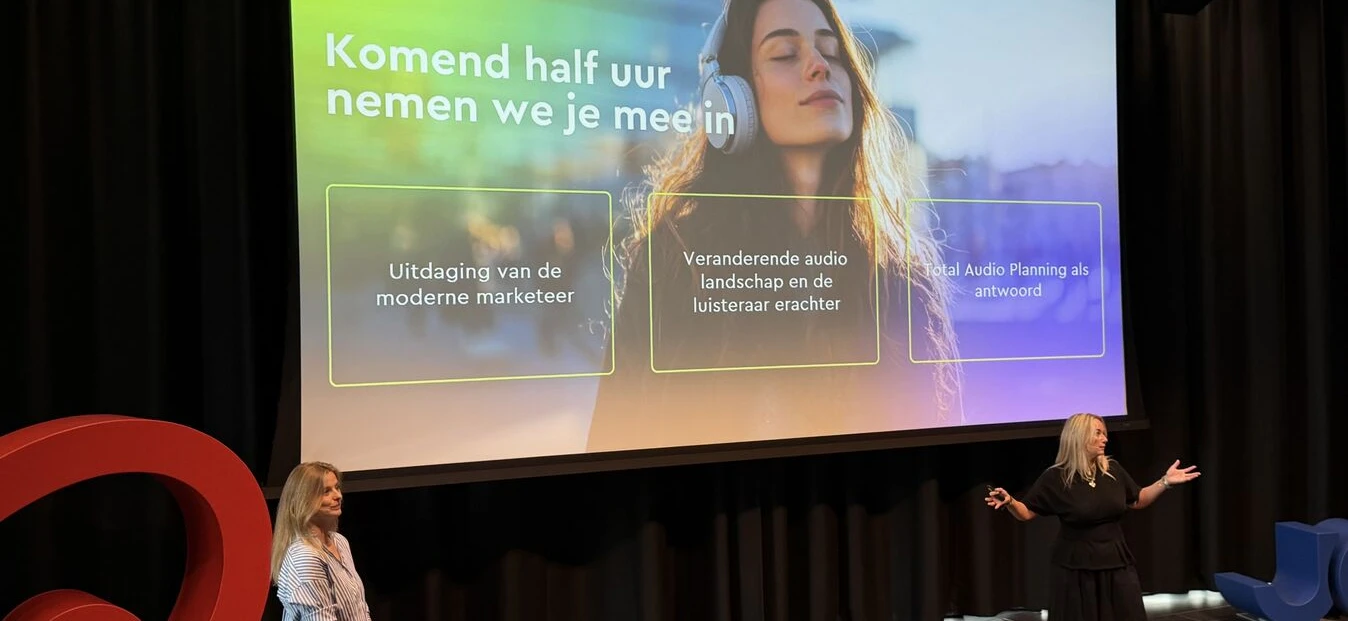
Consumers today spend more time consuming media than sleeping. Every day, we process between 4,000 and 10,000 commercial stimuli. In this overload of information, as many as 84% of all purchases take place with brands for which consumers have already built a clear preference beforehand. How can you, as a brand, make sure you are present in that decisive ‘priming stage’? During the Audio Summer School at DPG Media, Suzanne Bertus (Sr. Director Communications Planning) and Nelleke Delemarre (AV Strategic Manager) explored the strategic power of audio.
With an average listening time of 114 minutes per day, audio is a fixed part of our daily lives. Yet many advertisers still treat audio as an afterthought or purely tactical channel. A missed opportunity, because the figures show that audio plays a full-fledged and stimulating role in brand growth. To make proper use of that role, it is important to stop seeing audio as linear radio only. Today’s audio landscape consists of linear and online radio, streaming audio and podcasts, each with its own listening context, target audience and level of attention, which is exactly why the combination of these forms makes audio powerful within the media mix.
Total Audio Planning: The 3 Pillars
“For an impactful audio campaign, it is important that the target audience is always at the center. It is also important to take into account the role of audio within the objective and the form of the message being communicated.” - Nelleke Delemarre
From that statement, WPP Media introduces Total Audio Planning: a strategic framework that places consumer listening behavior at the center and looks beyond reach and frequency alone. By smartly combining the unique strengths of each audio platform, multiple relevant touchpoints with the target audience are created. Three pillars are central to this.
1. Audience First
Instead of planning around stations or platforms, the listener is placed at the center: how does a specific target audience move through the audio landscape? For example, the listener group for streaming audio and podcasts mainly consists of young people aged 18 to 34; 51% of this audience streams audio and 48% regularly listens to podcasts, while people aged 55+ make up the largest group within linear radio at 42%. By planning offline and online audio in combination, you can better respond to different listening behaviors and also reach the ‘screenless audience’ and light media users.
2. Objective-led (Touch, Tell, Sell)
The campaign objective determines the role audio plays within the funnel and which audio platform is the best fit. Audio can add value at every layer, as long as its use aligns with the phase: Touch, Tell or Sell.
Touch (Brand awareness & Image): In this layer, audio, in the form of a radio spot and a pre-roll on digital audio and podcasting, is effective for building top-of-mind recognition.
Tell (Consideration & Message Delivery): In this phase, you want to engage and convince the target audience. This can work very well with a podcast host-read or sponsorship. Radio spots and digital audio pre-rolls are also needed additionally to build reach.
Sell (Conversion & Action): Within the sell layer, audio can certainly be effective too. A radio spot or digital audio pre-roll with a clear call to action can work strongly within promotional campaigns, for example in combination with a podcast giveaway or promotional code.
3. Message-driven
The complexity of the message determines the spot length and format. For example, longer spot lengths, such as 30 seconds, have a significantly higher brand impact for substantive or emotional messages than 20-second spots.
The multiplier impact
When audio channels are used in an integrated way, they reinforce each other and the rest of the media mix. The data underlines this effect: combining radio, digital audio and podcasts delivers up to +11% additional reach. In addition, adding audio to a video or social campaign drives a 20–30% increase in brand recall, while combining TV and radio increases spontaneous ad recall by +12%.
6 action points for tomorrow’s media mix
Plan audio holistically: Don’t look at radio, streaming or podcasts in isolation, but combine them for maximum reach and impact.
Optimize for impact: Podcasts and streaming offer high attention value; use linear radio for scale and continuity.
Follow the listener: align your channel strategy with your target audience’s behavior; who can you reach, where and when?
Link audio to your objectives: Audio works across the full funnel, but each objective requires a different type of activation and content.
Leverage Addressable Audio: Make your message more personal and relevant with dynamic, data-driven audio activation.
Combine audio with visuals: More and more audio formats are also being converted into video content. To follow the listener and take a truly holistic approach, you should be present there as well.
Audio deserves a clear place in the media strategy: not as an add-on, but as a channel that strengthens brand preference and campaign effectiveness.