

Conversation 3: The Art
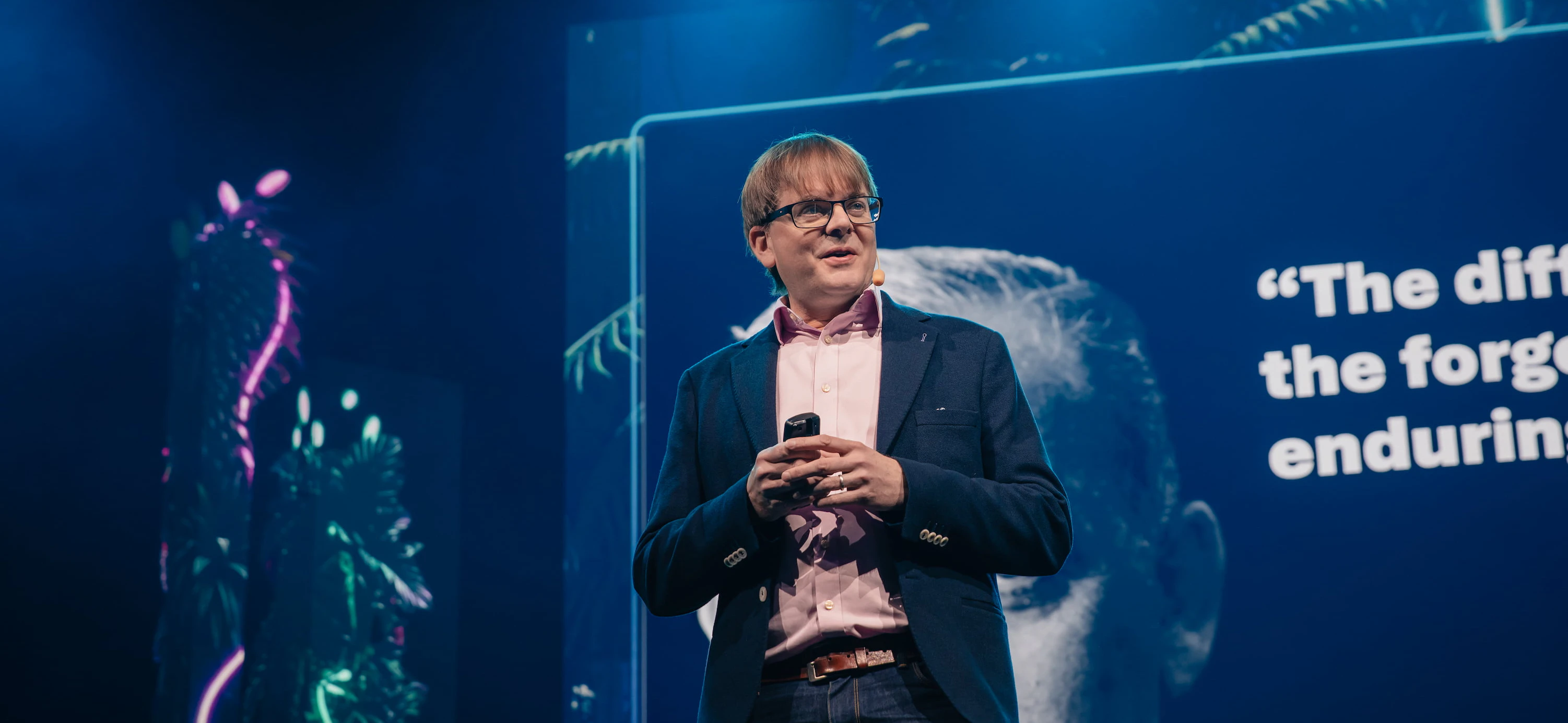
Orlando Wood has spent over two decades at System1 building the evidence base for what actually makes advertising work. His books Lemon and Look Out, and his course APE (Advertising Principles Explained) with Sir John Hegarty, have become required reading for anyone serious about effectiveness.
At NextM Nordics 2026, he laid out seven principles for treating advertising as art - truth, beauty, experience, possibility, story, drama, feeling - and made the case that applying them is what separates work that disappears from work that endures. Then the talk right after his went in the complete opposite direction, deep into performance optimisation. Which made our conversation inevitable.
Two schools, one industry stuck in one of them. Orlando talks about two schools of advertising: showmanship and salesmanship. They're not opposites. They work together. But over the last twenty years, the industry has fallen into a salesmanship rut - driven by media that gives you six seconds, targeting that assumes existing interest, and buying systems that reward efficiency over coherence. The irony: performance marketing principles aren't new. Split testing, redemption tracking, A/B testing - all of it can be found in 1905 print advertising. The technology has changed. The principles haven't. We just keep forgetting. And there's a mismatch in how we value these things. As Rory Sutherland puts it: you'd take a creative idea to a finance person for sign-off, but you'd never take a finance person's idea to a creative director for sign-off. The power is in the wrong place.
The ambition problem. The conversation we keep coming back to: is this actually an ambition problem? Performance marketing is very good at delivering a predictable 2% hike. Showmanship is what gets you exponential growth. As John Hegarty puts it: "Do you want incremental or do you want exponential?" Most of our industry has quietly decided incremental is safer. Big brands are, as Les Binet puts it, behaving like small brands - in their media choices and in the kind of creative they're willing to make.
The LLM twist. Here's the part marketers should really be paying attention to. LLMs favour coherent brands. As AI becomes a discovery and recommendation layer - replacing search, shaping consideration - the brands that get surfaced will be the ones with clear, consistent, distinctive identities. Meaningful narratives. Coherent characters. The stuff that feels like something. Incoherence will be punished. The six-second, fragmented, performance-only approach is building brands that LLMs can't even describe, let alone recommend. Orlando's hope is almost hopeful-destructive: that AI breaks the current system hard enough that the industry is forced to rebuild it properly. Back toward artistry. Back toward the kind of work that ends up in galleries. Work that speaks to something broader about our existence.
The strategic principle. Are you creating an ecosystem that can naturally thrive - or a helicopter-parent environment that will deliver 2% incremental growth with great ease and zero transformation? Systems and trust are the question now. Where AI sits in your workflow - and where it's kept out - signals what you actually value. Optimise the wrong bits and you get more efficient at producing work that won't endure.
Three questions to test your set-up:
Is AI optimising your salesmanship while starving your showmanship? Most automated buying and optimisation systems are brilliant at short-term spikes and terrible at coherent brand building. If your AI is only operating downstream - targeting, variant generation, placement - you're getting more efficient at producing work with no centre of gravity.
Are you protecting the happy accidents, or engineering them out? Orlando's point is sharp: the Dulux dog strayed onto set. The Smash Martian fell over. The Hofmeister bear's leaf fell by chance. These are the moments that make work unforgettable. They require humans on set, paying attention, with the authority to keep the accident in. No prompt produces this.
Are you building a brand an LLM can describe? If you asked ChatGPT or Claude to explain your brand in one sentence - would it have anything coherent to say? If your work has been a fragmented stream of six-second performance executions for three years, the answer is probably no. That's not a future problem. That's a right-now problem.
