
Nieuws25th Sep 2026
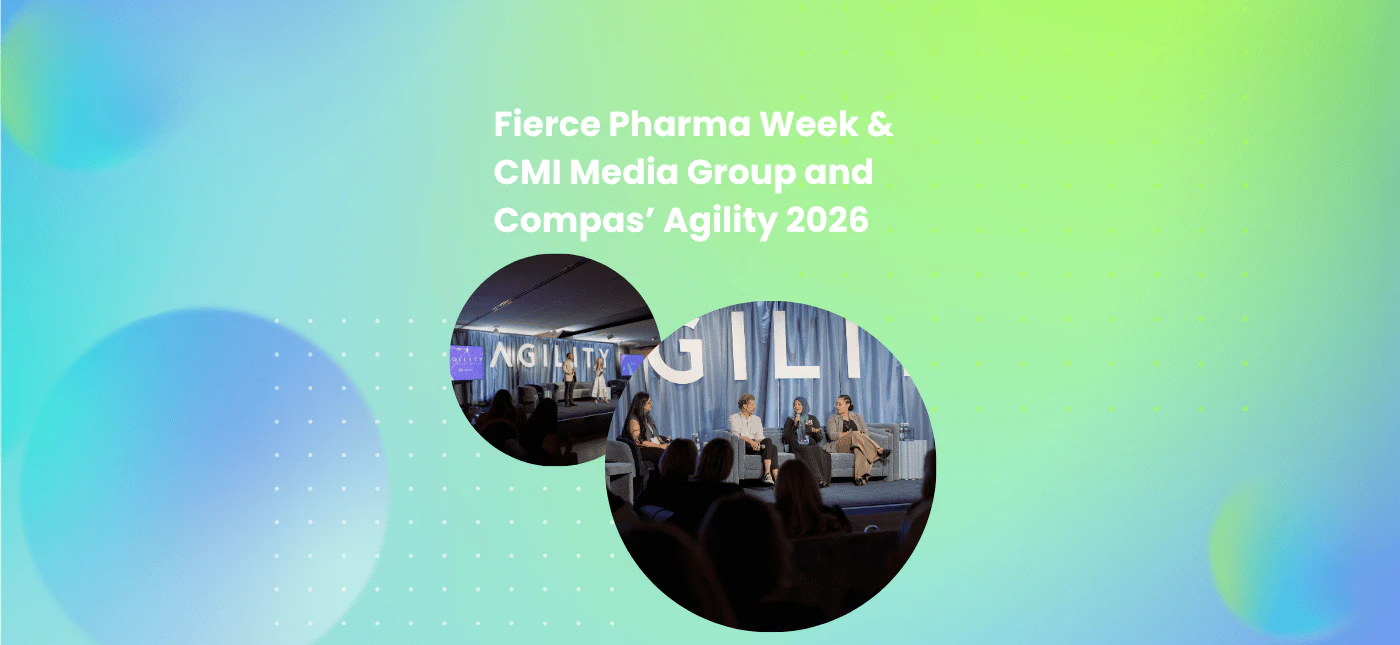
Fierce Pharma Week & CMI Media Group and Compas’ Agility 2026

Article's author
Share article
What the health & pharma marketing industry shared and learned about speed, trust, and the human work AI cannot replace.
Across Fierce Pharma Week 2026 and CMI Media Group and Compas’ Agility thought-leadership conference, the most important story was not that healthcare has leaned into AI. That part is already obvious. The more meaningful shift is that AI has moved from a tool brands experiment with to an operating condition they must now design around. Search is changing. Caregivers are changing. Communities are changing. The pressure on medical, marketing, and media teams is changing with them.
What emerged from the week was a tension between velocity and validity. Technology is making it easier to move faster, but health does not reward speed on its own. As WPP Global Chief AI Officer Dr. Daniel Hulme put it, true AI is "goal-directed adaptive behavior"; in healthcare, that goal still has to be accuracy, human understanding, and better decisions.
That is why the strongest insight of both conferences was also the simplest: The more the system accelerates, the more human judgment matters. As Zoë Lazarre, Chief Marketing Officer at Genentech, said, “As AI gets faster, human judgment becomes more - not less - important."
The future of health marketing will belong to organizations that can use AI to remove friction without removing accountability, empathy, or care.
The First Search Is No Longer a Search
The front door to health information is being rebuilt in real time. Patients and caregivers are no longer moving neatly from a search bar to a brand website to a physician conversation. They are asking full-sentence questions in conversational engines, testing what they hear against community forums, and arriving at appointments with information that has already been filtered by algorithms, creators, and peers.
Caregivers are the power users in this new environment. CMI Media Group’s Media Vitals research suggests that nearly half of caregivers are using AI tools daily to research symptoms, medication side effects, and complex diagnoses. It makes AI part of the emotional and administrative reality of caregiving, especially for people already sorting through pill bottles, insurance claims, discharge instructions, and unanswered questions.
The implication for brands is bigger than traditional SEO. Discovery now happens across three overlapping webs:
the human web of search engines and brand sites
the LLM web of conversational answers
the agentic web of systems that will increasingly act on behalf of users
In that world, clear and compliant brand information is the raw material AI systems use to explain a condition, compare options, and shape a patient’s next question.
That’s why the line from Google’s Stefanie Klaskow landed so cleanly in the room: “Good GEO is equal to good SEO”. The discipline around - generative engine optimization - GEO is about ensuring that when patients and caregivers ask health questions in new places, the information available to the AI tools that find it is structured, authoritative, and medically sound.
Trust Is Moving From Institutions to Communities
If AI is becoming the first explainer, communities are becoming the second opinion. People may use conversational tools for speed, but they still look for human validation before they believe what they read.
Reddit’s role in health decision-making captured that shift. Its structure of topic-specific communities, visible moderation, lived experience, and voting systems creates a different kind of credibility than a brand page or paid media unit can provide. Communities are places people go when the stakes are personal and the answer needs to feel tested by reality, and they want to know they’re not alone.
That same dynamic is visible in short-form video like TikTok. Younger audiences are often beginning with TikTok or creator-led explanations because the content feels approachable, fast, and human. Unfortunately, misinformation can travel with the same ease as education. But the behavior is not going away and it’s paramount that health brands show up with utility, humility, and accuracy in the places where people are already trying to make sense of their lives.
Governance Is the New Creative Discipline
The exciting change year over year at Fierce Pharma Week is that marketers were excited to move past the novelty of AI in the context of their brands and begin to interrogate how it can work for them . The biggest questions now are about the guardrails they can implement to maximize value in a compliant way, with true human accountability and oversight.
In low-risk environments, agentic systems lend the benefit of time. But healthcare is not a low-consequence category. Clinical messaging, patient targeting, compliance review, and brand representation require a different standard. Framing from Eugene Lee, Group President, Specialty Communications at CMI Media Group, gets to the heart of it: "The most important topic right now is accuracy, completeness, and proper representation of brand in health and science." Citations alone are not enough. A confident answer can still be wrong, and a sourced answer can still misrepresent the nuance that matters.
That makes governance less of a back-office control and more of a strategic capability. The organizations that win will be the ones that know which decisions deserve automation, which require human review, and where the cost of being almost right is too high.
Omnichannel Has Become an Operating Model
For years, omnichannel has been treated as a media and messaging ambition. This year’s conversations made clear that the word is now carrying more weight than that. In health, omnichannel only works when commercial, medical affairs, market access, field sales, and patient support are operating from a shared understanding of timing, readiness, and need.
Eugene Lee’s observation that "Omnichannel is not a new thing, but it’s an evolution of the complexities and the technological sophistication that we have at our disposal" is a useful reset. The opportunity is not more channels. It is better orchestration. Physician marketing may depend on precise NPI-level data, while consumer marketing depends on privacy-safe predictive models, but the strategic value appears in the overlap: the moment when a patient is seeking information and their provider is ready to have the right conversation.
That requires moving away from volume as the default measure of progress. Clicks, impressions, email blasts, and disconnected engagement signals can create the appearance of motion without producing a better healthcare experience. The more useful question is whether the system can recognize consequential signals and respond to them in a way that improves diagnosis, access, adherence, or trust.
The Patient Story Is not a Funnel
The most human moments of the week were reminders that health communication is never only about information transfer. It is about fear, stigma, confidence, agency, and the need to feel seen before being asked to act.
Genentech’s involvement of Damon Wayans in a campaign for Diabetic Macular Edema was a good example of creative risk in service of emotional access. Humor did not trivialize the condition. It gave people another way into a difficult conversation, helping break through fear and shame in a category where avoidance can delay care.
The GLP-1 conversation pointed in the same direction. Awareness is now mainstream, but the next phase of communication cannot depend on superficial transformation narratives. Patients need content that reflects the biological reality of obesity, the friction of insurance coverage, and the long-term nature of treatment. In other words, the story has to continue long after the moment of conversion.
Health marketing has to account for what happens before diagnosis, after prescription, and between every formal touchpoint where people are still living with the consequences of the condition. As Sargi Mann, EVP Strategy, CMI Media Group, said, "the funnel may end but the lives and stories continue."
What This Means for 2026 and 2027
The next phase of health marketing will reward organizations that can be both faster and more careful. To do that brands will need to:
Structure their digital ecosystems so AI can understand and cite them accurately.
Design for caregivers as a primary audience, not an afterthought.
Consider AI as an audience in itself. People are getting information from AI; brands need to be marketing to AI as though it was an influencer/content creator.
Ensure well governed AI operating models that make routine work more efficient while preserving human review for clinical, creative, and compliance-sensitive decisions.
Architect accountability from the top down and align on a process that is mutually beneficial for medical, commercial, and marketing teams.
Just as importantly, health and pharmaceutical brands will need to stop treating omnichannel as campaign architecture and start treating it as organizational design. The goal of omnichannel orchestration needs to evolve from being everywhere to recognizing when a person, caregiver, provider, or field team has reached a meaningful moment, and to respond with something useful, accurate, and human.
The Human Work Still Matters Most
Agility and Fierce Pharma Week ultimately pointed to a future that is both more automated and more dependent on human care. AI can synthesize, accelerate, monitor, and recommend. It can help caregivers manage complexity and help marketers understand signals faster. It cannot feel the stakes of a diagnosis. It cannot know when a technically correct message misses the human moment.
That responsibility remains with people. The brands that lead the next era of health marketing will not simply adopt AI faster, they will question legacy assumptions, build stronger systems of proof, participate more thoughtfully in communities, and use technology to make room for the judgment, empathy, and craft that health has always required.