

Conversation 1: The Brain
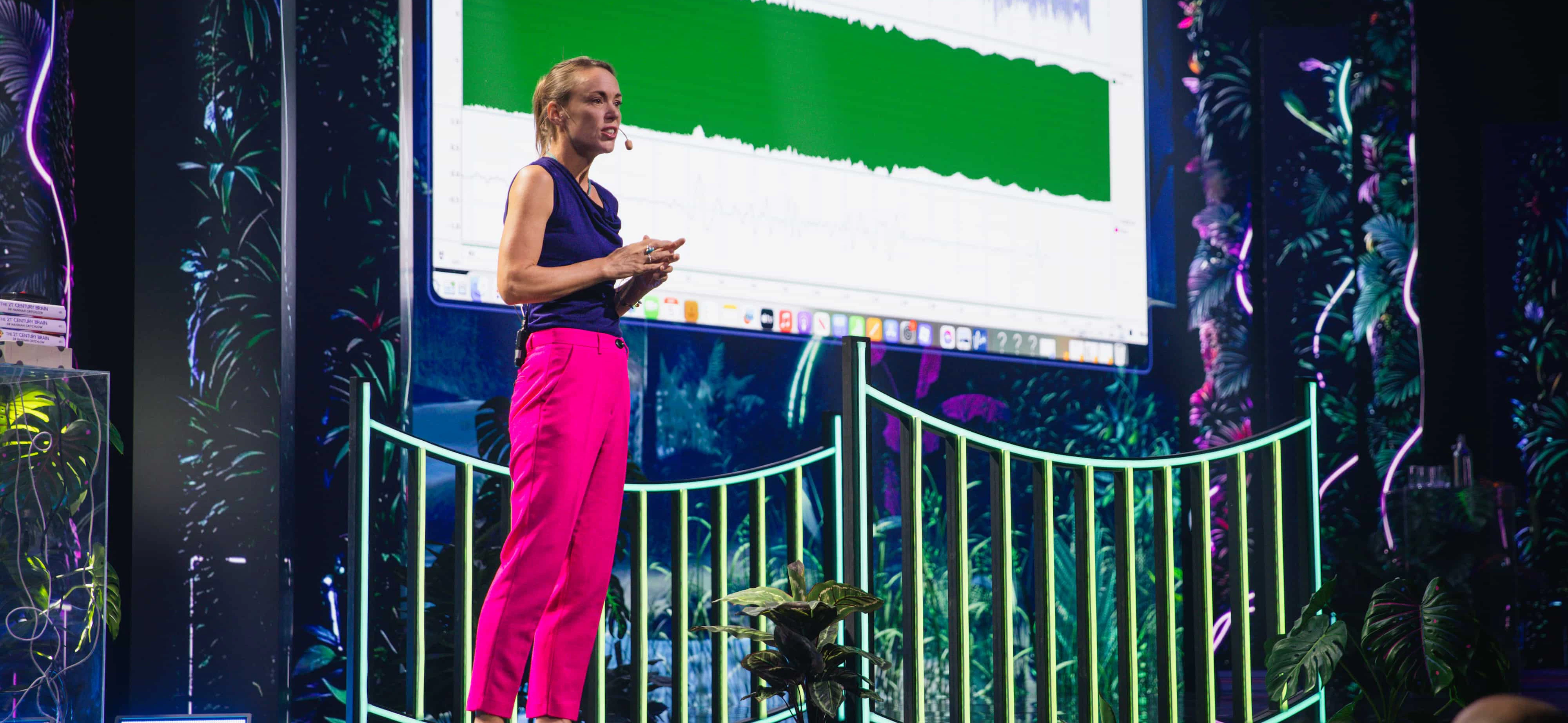
When neurologist Hannah Critchlow walked off the NextM Nordic 2026 main stage, she left hundreds of marketers doing something most keynotes never achieve: singing, running on the spot, and tuning into their own heartbeats. It wasn't a gimmick. It was a live demonstration of the thesis behind her new book, The 21st Century Brain: How to Future-Proof Our Minds in the Age of AI.
Human brains work better when they're connected to other brains. Not metaphorically. Measurably. Brainwaves synchronise. Ideas hop mind to mind. Problem-solving compounds. And in an industry currently pouring billions into AI tools designed primarily to let individuals work faster on their own, that finding should stop us in our tracks.
The beehive problem. Hannah's most powerful analogy came from a beehive. Professor Gene Robinson's research at Illinois shows that the bees that keep a hive alive when disaster strikes - a dead queen, an intruder alert - are the ones carrying genetic markers linked to autism in humans. While the majority get swept up in emotional contagion, these bees quietly keep the colony running. Other bees, carrying ADHD-like traits, forage further, take bigger risks, and come back with more rewards. Studies in humans show exactly the same pattern: ADHD is associated with heightened creativity, imagination, and entrepreneurial success. The lesson is biological, not ideological. A colony of identical bees dies. A team of identical thinkers converges on the same answer every time.
Where AI goes wrong. Hannah used AI as part of her book proposal - but not in the way you'd expect. It returned a summary of everything already out there. That told her exactly what her book shouldn't be. "The last thing you want is a sycophantic echo-chamber therapist," she told us. Yet that's precisely what most individual AI use becomes: a mirror that agrees with you, faster. The biotech examples she shared - MIT's AI-discovered antibiotic "Halicin," Tim Gilliams' work on rare disease treatments, DeepMind's protein-folding breakthrough - all share one thing. They're human-AI collaboration where the human brought the question, the judgement, and the interpretation. The AI brought speed across data no human could process alone.
The strategic principle. Are your AI systems collaborative - or are you just creating more space for siloed delivery and efficiency that gets you to the same place faster?
Most AI rollouts in our industry are designed for individuals. One person. One chat window. One output. That's not collaboration - that's solitary confinement with autocomplete.
Three questions to ask about your AI set-up this week:
Does it bring different brains together, or keep them apart? If your AI tools replace the conversations that used to happen across strategy, creative, data and production - you've shrunk your cognitive surface area, not expanded it.
Does it protect neurodiverse thinking, or flatten it? If everyone is prompting the same base model with similar training, you'll converge on similar answers. Where are the ADHD foragers in your workflow? The autistic-trait bees keeping things running when everything else is on fire? AI should amplify cognitive diversity, not average it out.
Are you using AI to clarify what something shouldn't be? Hannah's best use of AI was elimination, not creation. Most teams still use it as a generator. The teams that will win use it as an editor, a mirror, a sparring partner - then bring the human conviction.
