Insights30th Oct 2026•8 minute read
ANA Masters 2026: Brand Building Takes Center Stage

Article's author
Share article
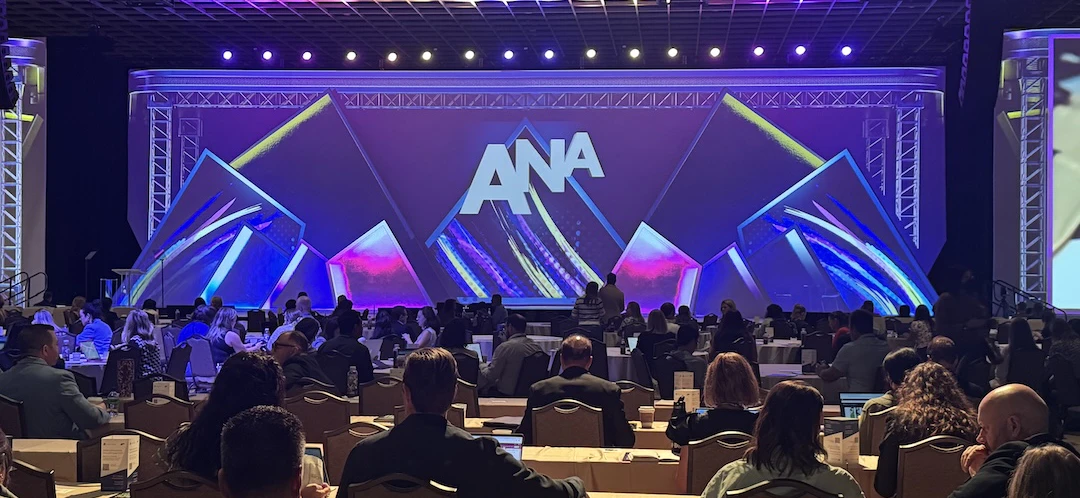
Each year, ANA Masters of Marketing brings the people responsible for the world's biggest brands onto one stage. This year in Orlando, under the theme "Catalyzing Growth," they arrived with results, and the same message came through in nearly every presentation.
Growth belongs to the marketers brave enough to take the leap, strip away what slows them down, and build around the passions that move people.
This year's conference also marked the end of an era. Bob Liodice steps down at the end of 2026 after 31 years at the ANA, 23 of them as CEO. Speakers thanked him from the stage throughout the week, and we join them in thanking Bob for a career that helped shape modern marketing.
Key Takeaways
Back to Basics. New tools arrive every week, but the fundamentals of growth haven't changed. Every decision should center around what your customers need or want and what your brand genuinely stands for.
Simplicity is speed. Extra approvals, redundant steps, and overloaded briefs slow the work, dull the idea, and disrupt the conversation. Cut what doesn't make the work better, and trust your people to act within clear guardrails.
Be brave, stay grounded. Some of the best work comes from brands willing to go big and have fun doing it.
Measure what actually matters. Stop tracking what's easiest to count and start tracking what changes behavior. Use testing to learn what your marketing actually changed and invest in what works.
Humans lead, AI accelerates. Use AI for speed and scale, and put the time it saves into the ideas and relationships only people can build.
Commit to passions, not moments. Moments fade, but passion lasts. Find the passions that drive your audience and how your brand can make those experiences better.
Don't borrow culture, build it. Give employees, partners, and customers something to believe in and belong to, and let it grow from the inside out.
Back to Basics
Media is fragmenting, commerce is speeding up, and AI is changing how the work gets done. Yet some of the week's strongest stories came from brands going back to marketing's first principles. Marcus Fischer, Chief Brand Officer at Harley-Davidson, described his first priority as protecting a brand built since 1903. "Do no harm for a brand that is so recognized and so celebrated," he said. Harley is shaping its next chapter by returning to the vision of its founders, who saw riding as a joyful lifestyle and a community, not a transaction.
Knowing the customer starts with being useful. Tim Castree, Chief Marketing Officer at DoorDash, said lasting growth comes from habits. "When a product experience meets a real-world need, people have that reason to return," he said. He explained that those repeated experiences shape what a brand comes to mean to people.
Takeaway: The first question isn't which new tool to adopt. It's whether every brief, plan, and channel decision traces back to a real customer need and a clear brand truth.
Simplicity Is Speed
If the fundamentals haven't changed, the pace has. Again and again, speakers described getting faster by removing things rather than adding them.
Fischer called marketing the art of reduction. Harley-Davidson has more than a century of brand equity to draw from, so the challenge was focus. "How do we get something into a single point that we can rally everybody behind?" he asked. The answer was one word, RIDE. "It's a verb. It's not a tagline," Fischer said.
Simplifying also means fewer layers between an idea and the market. Leaders across the week described empowering the people closest to the work, giving them room to create freely, with clear guardrails for what still needs to go up the chain.
Takeaway: There is more than one way to move faster. Some brands shrink the bet, testing an idea in a few markets or with a small budget before scaling what works. Others shorten the path, removing approvals that add time but not value. Both help brands join the conversation with customers instead of interrupting it.
Be Brave, Stay Grounded
Courage came up on nearly every stage, but the boldest work of the week was never reckless.
American Family Insurance offered the clearest example. With a share of voice of just 2% to 3% in a category dominated by big spenders, the insurer partnered with Disney Advertising to create Designed to Last, a four-part competition series on Hulu in which builders protect homes against wind, snow, and water. Sherina Smith, American Family's Chief Marketing Officer, was candid about the risks, from legal questions to funding conversations with leadership. "At a certain point, your fear can't overcome your ambition for the brand," she said.
Marcelo Kertesz, Chief Marketing Officer at MANSCAPED, said humor is what opens the door for the brand, while quality is what earns it permission to stay. That pairing helped a brand not yet ten years old become the number three player in U.S. electric shaving.
Takeaway: Give teams permission to take big creative swings and have fun with them, as long as each one starts from a real insight and stays true to the brand.
Measure What Actually Matters
Bold work only lasts if it can prove its value, and several leaders described changing what they measure to do it.
DoorDash brought the most rigor. Castree argued that holdout tests, which compare people who saw the marketing with people who didn't, are still underused. Across eight large advertising tests, DoorDash's use of control groups cut measurement noise by more than 90%. He also warned against confusing activity with impact. "Don't mistake personalization for persuasion. It often has the opposite effect," he said.
AB InBev no longer tracks impressions because impressions can be bought, and instead tracks how often people actually engage with its content. Other leaders urged marketers to judge their work by total brand sales, share, and profit growth rather than building an ROI case for every line item.
Measurement also gave brave ideas room to run. American Family used rapid-response focus groups from the day Designed to Last launched and is now running a marketing mix model on the show's business impact.
Amazon Ads pretested its small-business campaign through several rounds of edits until it scored among the top 0.2% of B2B ads, which gave the team confidence to go big.
Takeaway: Agree on the measures that matter before launch, separate what's easy to count from what actually moves the business, and use holdout tests to learn what is truly working.
Humans Lead, AI Accelerates
It is no secret that AI is a part of the everyday work, yet the conversation has shifted, again. This year, leaders talked less about what AI might replace and more about what it frees people to do, emphasizing the deeply human nature of our industry as its strongest asset.
Inside the DoorDash app, AI narrows hundreds of thousands of items to a few relevant choices in seconds. Yet Castree and Sudeep Das, Head of New Verticals, found in DoorDash's research that when AI surfaced several options, people still chose a brand they knew. "In the distributed world of agentic search, it makes brand more important, not less," Castree said. His advice was direct. "Don't bet on the agents. Bet on your systems."
AI is also making production dramatically faster. Marc S. Pritchard, Chief Brand Officer at P&G, described a P&G team that went from an idea to thousands of assets five times faster and five times cheaper than before. But the ideas still start with people. When P&G brought a U.S. dish spray to the U.K. under the Fairy brand, consumers rejected it because people there soak their dishes, a cultural ritual Pritchard said AI could have analyzed millions of data points and still not understood. "Robots don't build brands. Robots don't have fun. People do," he said.
The Ad Council and TikTok showed how the two work together. Athletes' personal stories about mental health came first, and TikTok's AI-powered tools found the communities that needed them, driving nearly one million visits to expert-vetted resources. "The human story, in my opinion, should always come first, but the technology can help take it to new heights," said Anthony Signorelli of the Ad Council, who presented alongside Liza Heller of TikTok.
Other leaders across the week made the same case. “I think we need to embrace technology big time. But this is and forever will be a human business,” said Marcel Marcondes, Global Chief Marketing Officer at AB InBev.
Julia Goldin, Chief Product & Marketing Officer at the LEGO Group, agreed. “Data is really important, but instinct and intuition are also very, very important,” she said.
Takeaway: Let AI carry the speed and scale while people carry the brand. Use AI to move faster and make sure it can find and accurately describe who you are, then invest the time it saves in the insights, stories, and relationships that only people can create.
Commit to Passions, not Moments
The most energetic moments of the week came when brands talked about what people love and how it makes them feel.
The brands growing fastest start by discovering what their audiences are truly passionate about, then going deeper. “Not just connecting superficially, but truly understanding the culture and the fandom connected to each passion point,” Goldin said of LEGO’s growth. That approach made LEGO one of the most recognized brands of this year’s World Cup without being an official sponsor.
AB InBev builds its brands the same way. “It’s very important to clarify that this is not about sponsorships,” Marcondes said. Instead, it’s about connecting the dots between big passion points and vocations that allow the brand to have a strong commercial execution and add something fans value.
Walmart took a similar approach in soccer, creating Walmart Saturday Showdown with Major League Soccer to give fans a weekly ritual rather than just another logo. “It is not about being outside of it, advertising at people. It is about participating inside of it," said Kim Tunick, Group Director, Brand Experiences & Partnerships at Walmart.
Creators directly influence how much of that passion travels. TikTok's Heller urged brands to share their goals with creators, then give them the freedom to tell the story in their own voice.
Takeaway: Stop chasing moments and start fueling passions. Discover what your audience truly loves, understand the culture around it, and find a role that adds something real to it.
Don't Borrow Culture, Build It
Some brands went beyond joining culture. They set out to create their own, and it started inside their own walls.
Harley-Davidson made its stance clear. While much of the week’s conversation focused on how brands can fit into culture, Fischer flipped the question. “We are culture, we make our culture,” he said. To rebuild that, Harley set out to bring back the joy and swagger of riding. It told photographers to capture riders’ smiles and moved the brand from intimidation to invitation, so more people would feel welcome. Fischer described the goal as a shot of dopamine. “We needed to remind our people, our dealers, and our riders of who we are,” he said. That started at home. Harley launched its new direction to employees first, then dealers, then riders, all in a single week.
LEGO showed how a brand can create a cultural moment of its own. LEGO Botanicals began as a hunch in 2021 and grew into a pop culture phenomenon, with adults building flower bouquets together on date nights.
Takeaway: Culture is built twice. First, by giving your own people something to believe in and a hand in building it. Then, by creating a culture around your brand that customers want to join, not just watch. The brands that get both right don’t have to borrow culture. They become one.
What This Means for Brands
Across four days in Orlando, the brands with the strongest growth stories weren’t the ones with the newest tools. They were the ones that knew exactly who they were and who they served, and had the nerve to act on it. They cut the layers that slowed them down, made big bets they could stand behind, and showed up for the things people already care about.
That’s the work ahead for every brand. Growth won’t come from doing more. It will come from doing less, more boldly, with people at the center. The next era of growth won’t be defined by the technology marketers use, but by how well they use it to stay human.
Keep Reading:
Will Responsible AI Be Deja Vu All Over Again? (MediaPost)
How AB InBev built a culture of creative effectiveness that drives growth (Marketing Dive)
'We have over-optimized everything': The pendulum swings back to brand-building at ANA Masters of Marketing (The Current)
Coca-Cola, P&G Explain How Stalled Brands Are Recapturing Growth (MediaPost)
The New HOW of Hispanic Advertising: AI, Culture, Identity, Language and the Future of Consumer Engagement (Hispanic Ad)
Verizon and Harley-Davidson Take Different Paths to Brand Reinvention (Chief Marketer)