
Insights9th Feb 2026•5 minute read
The End of Silos: How to Navigate the New Media-Services Ecosystem?
Article's author
Share article
For decades, we thought of the market in vertical silos: TV, Print, Radio, Outdoor. But the dynamics are changing, streaming is exploding, retail media is becoming essential, and more and more advertisers are energizing digital. Our latest edition of the Overview study, which presents a comprehensive look at the main media trends in consumption and advertising investment, illustrates this paradigm shift by establishing a new interpretation of the market, no longer based on the distribution channel, but on its usefulness for the brand and the consumer.
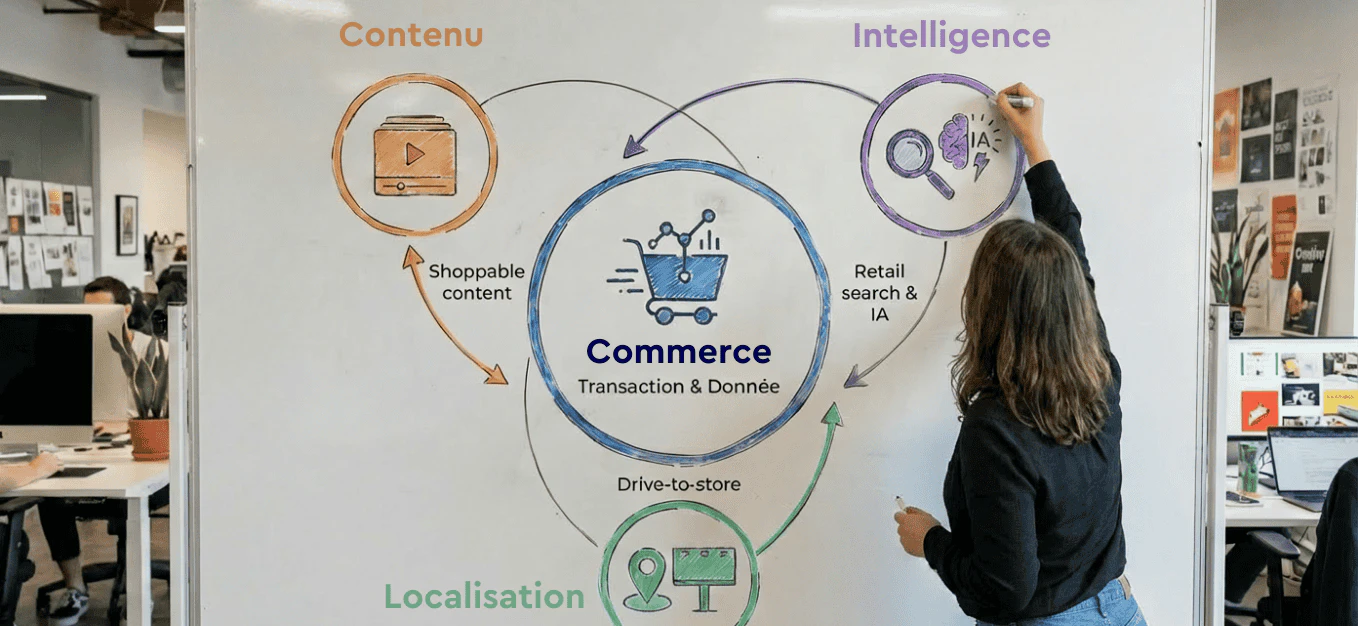
The ecosystem is now structured around four functional pillars:
Content (Attention and Culture): This is the domain of long-form engagement. The line between a TV show, a YouTube video by Squeezie, or a Twitch stream is blurring: everything is content.
Intelligence (Intention and Decision): These are search engines and, increasingly, AI assistants that reveal purchase intent before it even becomes explicit.
Location (Physical Environment): OOH (Out-Of-Home) is no longer just an exposure medium. With screen digitization (DOOH) and mobile data, the physical environment becomes an addressable and contextual surface.
Commerce (Transaction and Data): This is no longer just the place of purchas, it is a medium in its own right (Retail Media).
Content: Winning the Battle for Attention
Content is the most critical stake for brands, capturing 90% of time spent in contact with media. At the heart of this consumption, video dominates but is fragmenting radically. While linear television retains a majority share (>60%), it is in structural decline, especially among those under 50, for whom it has become a minority channel. We are witnessing a "platformization" of TV: the historic distinction between TV and SVOD (Netflix, Disney+) is fading in favor of alliances (like TF1+ on Netflix) and hybrid models funded by advertising. Even more striking, the boundaries between content creators and broadcasters are blurring: events like Squeezie’s GP Explorer rival traditional sports in audience numbers, transforming influencer-produced content into true mass media.
Go further - 2026 : Le virages des Plateformes Brodcaster
Social networks are also undergoing profound mutation. These spaces are no longer simple places for connection, but distinct platforms defined by their relevance to the user and the brand. TikTok is an entertainment platform (Content), Pinterest an inspiration platform (Intelligence), while WhatsApp remains focused on connection (the "self"). Time spent on these platforms continues to grow, driven massively by video formats, which now capture 57% of advertising investments in the sector.
The challenge for brands is no longer just to be present, but to understand that attention there is "voluntary" (skippable formats) rather than "forced," requiring creative codes adapted to retain the user.

The Audio Paradox and the Gaming Opportunity:
Audio: There is a massive disconnect between usage—1/3 of media time and a near-universal audience - and monetization (only 6% of ad revenue). The market is held back by fragmentation (radio, streaming, podcasts) and a lag in programmatic adoption, even though digital audio offers precise targeting opportunities.
Gaming: With 1.5 hours of daily consumption reaching all age groups, including those over 50, video games are a mass medium. Yet, advertising there is often confined to performance logic (app downloads). The report points toward a transition to "branding" via in-game advertising integration or e-sports sponsorship, so as not to disrupt the gaming experience.
Go further - Alexandra Chabanne (WPP Media) : « Les marques ne peuvent plus ignorer le gaming »
Finally, advertising effectiveness now relies on the ability to cross-reference data. Silos are falling: TV broadcasters (TF1, M6) are allying with retail giants (Amazon) to couple the power of media exposure with the precision of purchase data. In parallel, new influence models are emerging, such as "Social Publishing," where media outlets like Le Monde or Vogue become influencers themselves for brands.
Intelligence: From Generative AI to Agentic AI
Artificial Intelligence marks a profound mutation in our digital habits: we are moving from searching for links to generating answers. While Google retains its hegemony in France, the irruption of generative intelligences is upending the game: over the past year daily use of tools like ChatGPT has doubled, redefining user expectations.
The "Zero Click" Challenge: This transformation is accelerating with the integration of AI directly into results pages internationally (though not yet in France). AI Overviews are answers automatically generated by Google's AI, displayed before organic links. For informational queries, AI now synthesizes the answer, making the click to a website unnecessary. This "Zero Click Search" phenomenon is a major challenge for publishers. While brand visibility may increase (more impressions), website traffic is weakened. Due to these mutations, we estimate that practical content or encyclopedic platforms saw their organic traffic drop by 20% to 35% in 2025.
From SEO to GEO: A new discipline to emerge. Faced with this paradigm shift, Search Engine Optimization (SEO) must evolve towards GEO (Generative Engine Optimization). The strategic objective is no longer limited to ranking, but to citation: becoming the "source of truth" recommended by AI.
Go further - Search Experience : Au-delà du SEO, comment orchestrer votre visibilité à l'ère de l'IA ?
To achieve this, brands must tend to their "LLM Share of Voice" (Large Language Models). In the eyes of algorithms, credibility is now built outside the brand's site. Press articles, customer reviews, and discussions on forums like Reddit are becoming the primary fuel for AI. In this ecosystem, the mention becomes the new link, and external reputation the key to recommendation.
OOH: The Last Mass Media?
While linear television and radio suffer structural audience erosion, fragmented by the growth of streaming and podcasts, OOH displays unique resilience. Anchored in physical reality, it is the medium of movement that escapes content fragmentation. By bringing together the entire active population around a common experience, it stands out today as the last true mass medium, the only one capable of creating a simultaneous collective imagination.
Data shows remarkable stability in usage, with more than an hour spent traveling each day by the French population. While this exposure is homogeneous across the population, the medium demonstrates a particular resonance with young targets (15-24 years old), especially in transport where their dwell time is maximized.
The network now extends beyond the street. Semi-public living spaces—gyms (1.5 million people per day), cafés (12 million people per day), cinemas (500,000 people per day)—offer additional touchpoints, allowing for repetition and coverage work in contexts of relaxation or indoor leisure.
In 2026, OOH does more than just display; it interacts. The medium has recovered and exceeded its pre-pandemic investment levels, driven by the dynamic of DOOH. This format has even become the majority in "Shopping" environments, transforming the purchase journey.
This digitization offers brands the best of both worlds: the visual power of a medium that is "Brand Safe" by nature and non-skippable, coupled with the flexibility of digital. The time is ripe for contextualization: more than 30% of DOOH campaigns in France now integrate external data triggers (weather, stock status, road traffic) to broadcast the right message at the right moment.
Commerce and Strategy: Orchestrating Performance in the Era of Artificial Intelligence
Commerce has become the center of gravity for the other three functional pillars of this study. Why? Because the Commerce platform holds the most precious asset: transactional data. This data is the fuel that allows the real effectiveness of the other three pillars to be measured. We thus observe a "feedback loop":
Content platforms integrate commerce (Shoppable Content on TikTok or Instagram).
Intelligence platforms guide towards commerce (Retail Search constantly rising).
Location platforms activate commerce (Drive-to-store).
The customer journey has become the product itself. In a mature e-commerce market (80% of French people buy online), growth is now shifting from products to services. But above all, the boundary between physical and digital is blurring: while 11% of retail trade happens online, 70% of in-store sales are preceded by a digital search.
Go further - Commerce 2026 : « Le parcours est le nouveau produit »
The Battle of Entry Points and the Emergence of AI: The search reflex is today dominated by a leading trio: search engines (Google), retailer sites (Leclerc, Carrefour), and marketplaces (Amazon). Social networks remain, for the moment, confined to inspiration.
However, a new purchase interface is taking hold: the AI assistant. Already 25% of users resort to an AI before a purchase, seeking above all time savings and reassurance (comparisons, review synthesis). Driven by "Gen Z" (18-24 years old) who are defining tomorrow's standards, AI is transforming shopping into a conversation.
To exist in these new ecosystems, brands must readapt on three fronts:
Data Reliability: In the era of ROPO (Research Online, Purchase Offline), a stock or price error online breaks consumer trust; thus, product data must be impeccable.
Conversational Content: It is no longer enough to describe a product; one must answer the questions the AI will ask ("What is the best...?", "Compare X and Y").
Source of Truth: The brand must structure its data to feed AI agents and become the reliable reference.
For brands in 2026, the challenge is clear: it is about transforming attention (Content) and intention (Intelligence) into transaction (Commerce), while anchoring durably in the physical daily life of consumers (Location). Those who break down their own internal silos to embrace this hybridity will take a decisive lead. Performance will no longer come from excellence on an isolated channel, but from the ability to orchestrate fluidity between these four pillars.
To receive the presentation of our study Overview: Navigating the new media services ecosystem, contact your usual WPP Media contact.